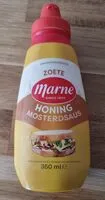
Vegetarian according to the ingredient list.
Ingredients 19
from most to leastWater. It comes first when the product holds a lot of it, as drinks, soups and sauces do.
Vegetable oil from rapeseed, low in saturated fat.
Mustard: one of the 14 allergens. Water: water. It comes first when the product holds a lot of it, as drinks, soups and sauces do. Mustard seed: seed of the mustard plant. Mustard is one of the 14 allergens.
More about mustard ›A sweet syrup made from starch, part of its glucose turned into fructose. An added sugar.
More about glucose syrup ›More about sugar ›Water: water. It comes first when the product holds a lot of it, as drinks, soups and sauces do. Mustard seed: seed of the mustard plant. Mustard is one of the 14 allergens.
Made by bees from flower nectar; mostly fructose and glucose.
Vinegar from fermented alcohol, usually from sugar beet.
Contains egg. Allergens are printed in bold or otherwise set apart on the label, so you can spot them quickly.
More about egg ›Table salt (sodium chloride). Adds taste and helps against spoiling. Adults are advised to eat no more than 6 grams a day.
Starch from maize (cornflour), to thicken. Gluten free.
Starch from wheat. Often purified to be gluten free, but it is a wheat product: the pack says whether it is gluten free.
More about gluten ›Maize starch treated so it thickens better and stays stable. Not genetic modification.
Adds smell and taste. ‘Flavouring’ on its own can be artificial too. Milk: contains milk (protein): one of the 14 allergens.
More about milk ›More about soy ›More about flavourings ›Makes a product thicker or creamier, like guar gum or xanthan gum. Guar gum: a thickener (E412) from the seeds of the guar bean.
Makes it more acidic, for taste and keeping. Which acid follows. Lactic acid: an acid (E270) formed by fermentation. Despite the name usually not from milk and without milk protein.
Slows the growth of moulds and bacteria, so it keeps longer. Which one follows.
More about preservatives ›More about sorbic acid and sorbates ›Dried parts of plants for taste, such as pepper, nutmeg or cinnamon. Which ones need not be said.
Slows fat or colour spoiling through oxygen. Which one follows (often ascorbic acid).
Adds colour. Which one follows, by name or E-number.
More about colourings ›
water, raapolie, 11% MOSTERD, (water, MOSTERDZAAD, natuurazijn, specerijen), glucose-fructosestroop, 5% Dijon MOSTERD (water, MOSTERDZAAD, natuurazijn, zout), 4,5% honing, natuurazijn, SCHARRELEI en SCHARRELEIGEEL, zout, maiszetmeel, TARWEZETMEEL, gemodificeerd maiszetmeel, aroma (bevat SOJA, MELK), verdikkingsmiddel (guarpitmeel), voedingszuur (melkzuur), conserveermiddel (E202), specerijen, antioxidant (E385), kleurstof (beta-caroteen).
- Energy315kcal
- Fat26 ghigh
- Sugars13 ghigh
- Salt1.9 ghigh
Per 100 ml.
Prices€ 2,29 at 4 shops
- Albert Heijn€ 2,29€ 6,54 / l
- Jumbo€ 2,29€ 6,54 / l
- Hoogvliet€ 2,29€ 6,54 / l
- PLUS€ 2,29€ 6,54 / l
Price history
The price history appears here.
The line is the regular shelf price, read every week, without temporary offers. Updated 2026-11-11.
Alternatives
On the same shelf ›Similar
See all Yildriz Noorse mosterd dille saus265 ml · € 2,99E3 shops
 Kühne Franse mosterd250 ml · € 1,43Dup to € 1,49 · 4 shops
 Sanmarco Franse mosterd370 g · € 0,98up to € 0,99 · 2 shops
 De Huisman Zaanse mosterd grof gemalen335 g · € 1,59D2 shops
More from Marne
See all Marne Franse mosterd235 g · € 1,79D3 shops
 Marne Franse mosterd200 g · € 1,75Dup to € 1,79 · 4 shops
 Marne Franse mosterd225 g · € 1,65Dup to € 1,69 · 5 shops
 Marne Franse mosterdsaus350 ml · € 2,39D3 shops
 Marne Groninger mosterd grof en pittig235 g · € 1,65Dup to € 1,79 · 4 shops
More choice on this shelf
Lists, in Dutch, with every product’s ingredients; the number is how many are on it.
Without what this contains
Something wrong? Report it
Label seen . The data is collected from supermarket websites and may differ from the pack.
Photos: Open Food Facts, CC BY-SA