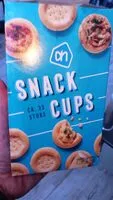
Vegetarian according to the ingredient list. Note: mono- and diglycerides (E471) can come from animal fat.
Ingredients 17
from most to leastGround wheat without bran and germ. Contains gluten.
More about gluten ›Glucose syrup is a sweet syrup, usually made from corn or wheat starch. It sweetens, keeps products soft and is cheaper than sugar. Glucose-fructose syrup is the same with more fructose in it.
More about glucose syrup ›More about sugar ›Fat from the fruit of the oil palm, partly saturated and solid at room temperature.
More about palm oil ›Starch from wheat. Often purified to be gluten free, but it is a wheat product: the pack says whether it is gluten free.
Contains milk. Allergens are printed in bold or otherwise set apart on the label, so you can spot them quickly.
More about milk ›Contains egg. Allergens are printed in bold or otherwise set apart on the label, so you can spot them quickly.
More about egg ›Makes dough rise by forming gas, like baking powder (sodium bicarbonate with an acid). Diphosphates: phosphate salts (E450), as a raising agent or to help meat hold its moisture. Sodium carbonates: baking soda and related substances (E500); they make dough rise.
More about phosphates ›Table salt (sodium chloride). Adds taste and helps against spoiling. Adults are advised to eat no more than 6 grams a day.
Contains milk. Allergens are printed in bold or otherwise set apart on the label, so you can spot them quickly.
Fibre from wheat, for structure and extra fibre.
Makes a product thicker or creamier, like guar gum or xanthan gum. Xanthan gum: a thickener (E415), made by bacteria fermenting sugar.
Lets fat and water mix without separating, as in mayonnaise or chocolate. Which one follows (often lecithin). Mono- and diglycerides of fatty acids: emulsifiers (E471) made from fat, vegetable or animal; the label need not say which. Lecithins: emulsifiers (E322), usually from soy or sunflower. From soy, the label has to name soy.
A fungus that makes dough rise or ferments sugar.
Protein from milk. Contains milk.
An extract of yeast with a savoury taste; it holds glutamate by nature.
More about yeast extract ›Grape sugar (glucose), usually made from starch. Less sweet than ordinary sugar and absorbed quickly.
Vegetable oil from sunflower seeds, mostly unsaturated fat.
tarwebloem, glucosestroop, palmvet, tarwezetmeel, vegetarisch weipoeder, scharrelei-eiwitpoeder, rijsmiddel (ammoniumcarbonaat [E503], difosfaten [E450], natriumcarbonaten [E500]), zout, melkpoeder, tarwevezel, verdikkingsmiddel (cellulosegom [E466], xanthaangom [E415]), emulgator (sucrose-ester van vetzuren [E473], mono- en diglyceriden van vetzuren [E471], lecithinen [E322]), gist, melkeiwit, gistextract, dextrose, zonnebloemolie. Waarvan toegevoegde suikers 2.6g per 100 gram en waarvan toegevoegd zout 0.87g per 100 gram
Label changed on 4 October 2026
- Energy475kcal
- Fat20 ghigh
- Sugars4.6 glow
- Salt1.5 gmedium
Per 100 g.
Prices€ 1,05 at Albert Heijn
- Albert Heijn€ 1,05€ 7,00 / kg
Price history
The price history appears here.
The line is the regular shelf price, read every week, without temporary offers. Updated 2026-10-19.
Alternatives
On the same shelf ›Similar
See all AH Biologisch Melba toast met sesamzaadjes100 g · € 1,39C1 shop
 Van der Meulen Melba toast naturel120 g · € 1,47Cup to € 1,59 · 3 shops
 Van der Meulen Melba toast sesam120 g · € 1,47Cup to € 1,59 · 3 shops
 Van der Meulen Melba toast volkoren120 g · € 1,47Cup to € 1,59 · 3 shops
 Van der Meulen Melba toast meergranen120 g · € 1,59C2 shops
More from AH
See all


More choice on this shelf
Lists, in Dutch, with every product’s ingredients; the number is how many are on it.
Without what this contains
Something wrong? Report it
Label seen . The data is collected from supermarket websites and may differ from the pack.
Photos: Open Food Facts, CC BY-SA