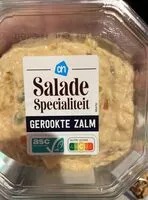
Ingredients 22
from most to leastPotato.
Contains fish. Allergens are printed in bold or otherwise set apart on the label, so you can spot them quickly.
More about fish ›Water. It comes first when the product holds a lot of it, as drinks, soups and sauces do.
Vegetable; which one often follows. Celery: celery: one of the 14 allergens. Carrot: carrot.
More about celery ›Vegetable oil from rapeseed, low in saturated fat.
Acid made by fermentation, usually of alcohol. Adds taste and helps against spoiling.
Usually granulated sugar from sugar beet or cane. An added sugar: it sweetens and gives colour and structure in baking.
More about sugar ›Table salt (sodium chloride). Adds taste and helps against spoiling. Adults are advised to eat no more than 6 grams a day.
Contains egg. Allergens are printed in bold or otherwise set apart on the label, so you can spot them quickly.
More about egg ›Concentrated tomato.
Starch from maize (cornflour), to thicken. Gluten free.
Maize starch treated so it thickens better and stays stable. Not genetic modification.
Dried parts of plants for taste, such as pepper, nutmeg or cinnamon. Which ones need not be said.
More about mustard ›Slows the growth of moulds and bacteria, so it keeps longer. Which one follows. Potassium sorbate: a preservative (E202), the salt of sorbic acid; it slows moulds and yeasts. Sodium benzoate: a preservative (E211); it slows moulds and yeasts in acidic products like soft drinks.
More about preservatives ›More about sorbic acid and sorbates ›More about benzoic acid and benzoates ›Dried or fresh leaves of plants for taste, such as parsley or thyme. Which ones need not be said.
Makes a product thicker or creamier, like guar gum or xanthan gum. Xanthan gum: a thickener (E415), made by bacteria fermenting sugar. Guar gum: a thickener (E412) from the seeds of the guar bean.
Makes it more acidic, for taste and keeping. Which acid follows. Lactic acid: an acid (E270) formed by fermentation. Despite the name usually not from milk and without milk protein.
Keeps the acidity at a set level, for taste, colour and keeping.
Adds colour. Which one follows, by name or E-number. Carotenes: orange colours (E160a), the same as in carrots.
More about colourings ›- 20Lime juice concentrate Limoensapconcentraat
The product is smoked: that adds taste and helps it keep.
Flavouring from a natural source, such as a plant, a fruit or fermentation.
More about flavourings ›
35% aardappel, 16% zalm, water, groente (selderij, wortel, augurk, doperwt), raapolie, azijn, suiker, zout, vrije-uitloopeigeel, tomatenpuree, maïszetmeel, gemodificeerd maïszetmeel, specerijen (o.a. mosterd), conserveermiddel (kaliumsorbaat [E202], natriumbenzoaat [E211], natriumdisulfiet [E223]), kruiden, verdikkingsmiddel (xanthaangom [E415], guarpitmeel [E412]), voedingszuur (melkzuur [E270]), zuurteregelaar (gebufferde azijn [E267]), kleurstof (carotenen [E160a]), limoensapconcentraat, rook, natuurlijk aroma. Waarvan toegevoegde suikers 2.0g per 100 gram en waarvan toegevoegd zout 1.27g per 100 gram
Label changed on 20 September 2026
- Energy195kcal
- Fat14 gmedium
- Sugars3 glow
- Salt1.3 gmedium
Per 100 g.
Prices€ 2,99 at Albert Heijn
- Albert Heijn€ 2,99€ 7,48 / kg
Also as a multipack
- AH Salade specialiteit gerookte zalm 2-pack at Albert Heijn: € 5,80 Offer
- AH Salade specialiteit gerookte zalm 3-pack at Albert Heijn: € 8,52 Offer
- AH Salade specialiteit gerookte zalm 4-pack at Albert Heijn: € 10,76 Offer
Price history
The price history appears here.
The line is the regular shelf price, read every week, without temporary offers. Updated 2026-09-01.
Alternatives
On the same shelf ›


More choice on this shelf
Lists, in Dutch, with every product’s ingredients; the number is how many are on it.
Without what this contains
- Everything without eggevery shelf
- Everything without mosterdevery shelf
- Everything without selderijevery shelf
- Everything without visevery shelf
Other choices for fish salad
Something wrong? Report it
Label seen . The data is collected from supermarket websites and may differ from the pack.
Photos: Open Food Facts, CC BY-SA