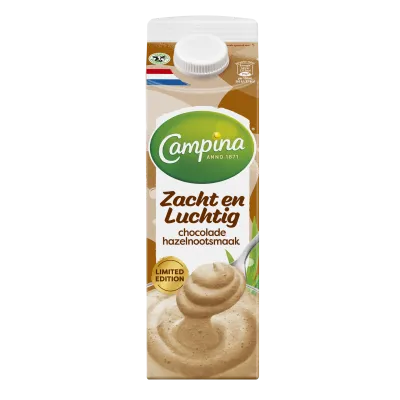
Vegetarian according to the ingredient list. Note: mono- and diglycerides (E471) can come from animal fat.
Fits you
See all
Ingredients 15
from most to leastContains milk. Allergens are printed in bold or otherwise set apart on the label, so you can spot them quickly.
More about milk ›Water. It comes first when the product holds a lot of it, as drinks, soups and sauces do.
Usually granulated sugar from sugar beet or cane. An added sugar: it sweetens and gives colour and structure in baking.
More about sugar ›Oils from plants; which ones are sometimes given in brackets. Palm oil has to be named. Coconut: the flesh of the coconut. In the EU it does not count as the allergen ‘nuts’.
More about palm oil ›Maize starch treated so it thickens better and stays stable. Not genetic modification.
Glucose syrup is a sweet syrup, usually made from corn or wheat starch. It sweetens, keeps products soft and is cheaper than sugar. Glucose-fructose syrup is the same with more fructose in it.
More about glucose syrup ›Contains milk. Allergens are printed in bold or otherwise set apart on the label, so you can spot them quickly.
Contains milk. Allergens are printed in bold or otherwise set apart on the label, so you can spot them quickly.
Hydrogenated fats are vegetable oils that have been made solid. Partially hydrogenated fats may contain trans fat; fully hydrogenated ones do not.
More about hydrogenated fats ›Makes a product thicker or creamier, like guar gum or xanthan gum. Carrageenan: a thickener (E407) from red seaweed, often in dairy. Xanthan gum: a thickener (E415), made by bacteria fermenting sugar.
More about carrageenan (e407) ›Lets fat and water mix without separating, as in mayonnaise or chocolate. Which one follows (often lecithin). Soya lecithin: an emulsifier (E322) from soy. Contains soy, if only a little.
Table salt (sodium chloride). Adds taste and helps against spoiling. Adults are advised to eat no more than 6 grams a day.
Adds smell and taste. ‘Flavouring’ on its own can be artificial too.
More about flavourings ›Adds colour. Which one follows, by name or E-number.
More about colourings ›Keeps a product in shape, so it does not separate or settle. Which one follows.
More about phosphates ›
Halfvolle MELK, water, suiker, plantaardige oliën (palm, palmpit, kokos, raapzaad), gemodificeerd maïszetmeel, glucosestroop, MELKewit, karneMELKpoeder, geharde palmpitolie, verdikkingsmiddel: carrageen, xanthaangom; emulgator: sojalecithine, E435, E472b, E472e; zout, aroma (MELK), kleurstof: E150d, bètacaroteen; stabilisator: E331, E339, E460, E466.
Label changed on 8 September 2026
- Energy87kcal
- Fat4.6 gmedium
- Sugars7.8 gmedium
- Salt0.1 glow
Per 100 ml.
Prices€ 2,34 – € 2,39 · 4 shops
- HoogvlietLowest price€ 2,34€ 2,34 / lLowest
- Albert Heijn€ 2,39€ 2,39 / l+ € 0,05 more
- Jumbo2 voor € 3,49 until 1 December€ 2,39€ 2,39 / l+ € 0,05 more
- PLUS€ 2,39€ 2,39 / l+ € 0,05 more
Price history
The price history appears here.
The line is the regular shelf price, read every week, without temporary offers. Updated 2026-11-25.
Alternatives
On the same shelf ›Similar
See all Zuivelhoeve Boer'n duo vla vanille chocolade450 g · € 1,78Cup to € 1,89 · 4 shopsMelkunie Vla chocolade1 liter · € 0,991 shopZuivelhoeve Boern duo vla vanille chocolade200 g · € 1,191 shopChocolade Vla 1 L1 L · € 1,341 shop
 Melkunie Citroensmaak vla0,5 l · € 1,39C3 shops
 Melkunie Rum rozijnen vla1 l · € 0,99Cup to € 2,29 · 4 shops
More from Campina
See all Campina Zacht en luchtig banaansmaak1 l · € 2,39C3 shops
 Campina Zacht en luchtig framboos smaak1 l · € 2,25Cup to € 2,39 · 5 shops
 Botergoud Ongezouten Roomboter Wikkel400 g · € 4,79E4 shops
 Campina Appel Kaneel Vla 1L · € 2,69up to € 2,77 · 2 shops
 Campina Bolletjes Vla Vanille Smaak 1 L · € 2,392 shopsCampina Botergoud 50% minder vet225 g · € 2,45
More choice on this shelf
Lists, in Dutch, with every product’s ingredients; the number is how many are on it.
Without what this contains
Something wrong? Report it
Label seen . The data is collected from supermarket websites and may differ from the pack.
Photos: Open Food Facts, CC BY-SA; Campina