Ingredients 27
from most to leastWater. It comes first when the product holds a lot of it, as drinks, soups and sauces do.
Pork.
Contains peanut. Allergens are printed in bold or otherwise set apart on the label, so you can spot them quickly.
More about peanut ›Usually granulated sugar from sugar beet or cane. An added sugar: it sweetens and gives colour and structure in baking.
More about sugar ›Dried skimmed milk. Contains milk.
More about milk ›Usually wheat flour: ground grain without bran. Contains gluten when it is from wheat. Soya: soy: one of the 14 allergens.
More about gluten ›More about soy ›Onion, fresh or dried.
Oils from plants; which ones are sometimes given in brackets. Palm oil has to be named. Peanut: peanut: a legume, and an allergen of its own apart from nuts.
Chilli pepper; adds heat.
Table salt (sodium chloride). Adds taste and helps against spoiling. Adults are advised to eat no more than 6 grams a day.
Starch treated so it thickens better and stays stable when heated or frozen. Not genetic modification.
- 12Sugar syrup Suikerstroop
Dried parts of plants for taste, such as pepper, nutmeg or cinnamon. Which ones need not be said.
The dark syrup left over from making sugar; adds colour and a bitter, caramel-like taste.
Flavouring from a natural source, such as a plant, a fruit or fermentation.
More about flavourings ›A powder of broken-down starch, slightly sweet. Adds bulk and a fuller texture.
Protein from soybeans. Contains soy.
Soybeans: a legume, and one of the 14 allergens.
A grain with gluten.
- 20Caramelised sugar Gekarameliseerde suiker
A thickener from maize, potato or wheat, for example. When it comes from a grain with gluten, the label has to say so.
An extract of yeast with a savoury taste; it holds glutamate by nature.
More about yeast extract ›Let fat and water mix without separating. Which ones follow.
More about phosphates ›- 24Lemon juice powder Citroensappoeder
Keep the acidity at a set level, for taste, colour and keeping. Acetic acid: the acid in vinegar (E260). Citric acid: an acid found naturally in citrus fruit (E330). Gives a fresh taste and helps keep the product.
Slow moulds and bacteria, so it keeps longer. Which ones follow.
More about preservatives ›More about sorbic acid and sorbates ›More about benzoic acid and benzoates ›Keeps a product in shape, so it does not separate or settle. Which one follows.
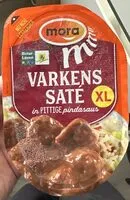
water, varkensvlees* 30%, geroosterde PINDA 16%, suiker, magere MELKpoeder, bloem (bevat TARWE, SOJA), ui, plantaardige oliën (raapzaad, PINDA), chilipeper, zout, gemodificeerd zetmeel, suikerstroop, specerijen, melasse, natuurlijk aroma, maltodextrine, SOJA-eiwit, SOJAbonen, TARWE, gekarameliseerde suiker, zetmeel (bevat TARWE), gistextract, emulgatoren: E451 en E450, citroensappoeder, zuurteregelaars: azijnzuur en citroenzuur, conserveermiddelen: E202 en E211, stabilisator: E452. *Beter Leven keurmerk 1 ster.
- Energy212kcal
- Fat13 gmedium
- Sugars8.5 gmedium
- Salt1.1 gmedium
Per 100 g.
Alternatives
On the same shelf ›


More choice on this shelf
Lists, in Dutch, with every product’s ingredients; the number is how many are on it.
Without what this contains
- Meal snacks without milk36
- Meal snacks without lactose36
- Meal snacks without peanut38
- Meal snacks without soy24
- Everything without glutenevery shelf
Other choices for satay
Something wrong? Report it
Label seen . The data is collected from supermarket websites and may differ from the pack.
Photos: Open Food Facts, CC BY-SA