Ingredients 22
from most to leastContains fish. Allergens are printed in bold or otherwise set apart on the label, so you can spot them quickly.
More about fish ›Usually wheat flour: ground grain without bran. Contains gluten when it is from wheat. Wheat: a grain with gluten. Rice: a grain without gluten.
More about gluten ›A grain without gluten.
Vegetable oil from rapeseed, low in saturated fat.
Starch from potatoes, to thicken. Gluten free.
Dried parts of plants for taste, such as pepper, nutmeg or cinnamon. Which ones need not be said.
Keeps the acidity at a set level, for taste, colour and keeping. Sodium carbonates: baking soda and related substances (E500); they make dough rise. Sodium citrates: salts of citric acid (E331) that control acidity.
More about milk ›Slows fat or colour spoiling through oxygen. Which one follows (often ascorbic acid). Ascorbic acid: vitamin C (E300). Slows browning and works as an antioxidant. Citric acid: an acid found naturally in citrus fruit (E330). Gives a fresh taste and helps keep the product.
Table salt (sodium chloride). Adds taste and helps against spoiling. Adults are advised to eat no more than 6 grams a day.
An extract of yeast with a savoury taste; it holds glutamate by nature.
More about yeast extract ›A fungus that makes dough rise or ferments sugar.
Contains gluten. Allergens are printed in bold or otherwise set apart on the label, so you can spot them quickly.
Contains egg. Allergens are printed in bold or otherwise set apart on the label, so you can spot them quickly.
More about egg ›Water. It comes first when the product holds a lot of it, as drinks, soups and sauces do.
Makes dough rise by forming gas, like baking powder (sodium bicarbonate with an acid). Diphosphates: phosphate salts (E450), as a raising agent or to help meat hold its moisture.
More about phosphates ›Fibre from wheat, for structure and extra fibre.
Lets fat and water mix without separating, as in mayonnaise or chocolate. Which one follows (often lecithin).
A syrup from barley malt, for taste and colour. Contains gluten.
Glucose syrup is a sweet syrup, usually made from corn or wheat starch. It sweetens, keeps products soft and is cheaper than sugar. Glucose-fructose syrup is the same with more fructose in it.
More about glucose syrup ›More about sugar ›Usually granulated sugar from sugar beet or cane. An added sugar: it sweetens and gives colour and structure in baking.
Grape sugar (glucose), usually made from starch. Less sweet than ordinary sugar and absorbed quickly.
Protein from milk. Contains milk.
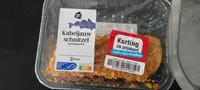
60% kabeljauw, bloem (tarwe, rijst), maïs, raapolie, aardappelzetmeel, specerijen, zuurteregelaar (natriumcarbonaten [E500], natriumcitraten [E331], melkzuur [E270], appelzuur [E296]), antioxidant (ascorbinezuur [E300], citroenzuur [E330]), zout, gistextract, gist, tarwe-eiwit, vrije-uitloopeipoeder, water, rijsmiddel (difosfaten [E450]), tarwevezel, emulgator (methylcellulose [E461]), gerstemoutextract, glucosestroop, suiker, dextrose, melkeiwit. Waarvan toegevoegde suikers 0.5g per 100 gram en waarvan toegevoegd zout 0.33g per 100 gram
Label changed on 4 October 2026
- Energy208kcal
- Fat8.2 gmedium
- Sugars0.8 glow
- Salt1.1 gmedium
Per 100 g.
Prices€ 2,69 at Albert Heijn
- Albert HeijnOffer until 29 November€ 2,69€ 14,94 / kg
Also as a multipack
- AH Kabeljauwschnitzel 2 stuks 2-pack at Albert Heijn: € 5,38 Offer
- AH Kabeljauwschnitzel 2 stuks 3-pack at Albert Heijn: € 8,07 Offer
- AH Kabeljauwschnitzel 2 stuks 4-pack at Albert Heijn: € 10,76 Offer
Price history
The price history appears here.
The line is the regular shelf price, read every week, without temporary offers. Updated 2026-11-24.
Alternatives
On the same shelf ›More from AH
See all

More choice on this shelf
Lists, in Dutch, with every product’s ingredients; the number is how many are on it.
Without what this contains
Something wrong? Report it
Label seen . The data is collected from supermarket websites and may differ from the pack.
Photos: Open Food Facts, CC BY-SA