Ingredients 35
from most to leastGround wheat without bran and germ. Contains gluten.
More about gluten ›Water. It comes first when the product holds a lot of it, as drinks, soups and sauces do.
Vegetable; which one often follows. Tomato: tomato.
Contains fish. Allergens are printed in bold or otherwise set apart on the label, so you can spot them quickly.
More about fish ›- 5Gherkin Augurk
Oil from a plant; which one is sometimes given in brackets. Palm oil has to be named.
More about hydrogenated fats ›Acid made by fermentation, usually of alcohol. Adds taste and helps against spoiling.
Usually granulated sugar from sugar beet or cane. An added sugar: it sweetens and gives colour and structure in baking.
More about sugar ›Ground maize. Gluten free.
- 10Maïsvlok1,3%
A sweet syrup made from starch, part of its glucose turned into fructose. An added sugar.
More about glucose syrup ›- 12Maize semolina Maïsgries0,9%
Yeast that makes dough rise.
- 14Sunflower seed Zonnebloempit
The protein in wheat that makes dough stretch. Not for anyone who avoids gluten.
- 16Pea fibre Erwtenvezel
Table salt with iodine. In the Netherlands iodine comes mostly through such salt in bread and cold cuts.
Egg yolk from barn hens. Contains egg.
More about egg ›Makes a product thicker or creamier, like guar gum or xanthan gum. Xanthan gum: a thickener (E415), made by bacteria fermenting sugar. Guar gum: a thickener (E412) from the seeds of the guar bean.
Maize starch treated so it thickens better and stays stable. Not genetic modification.
Contains gluten. Allergens are printed in bold or otherwise set apart on the label, so you can spot them quickly.
An aid that makes dough stronger or more supple, often ascorbic acid (vitamin C). Ascorbic acid: vitamin C (E300). Slows browning and works as an antioxidant.
Ground sprouted and dried wheat; gives bread colour and taste. Contains gluten.
Dried parts of plants for taste, such as pepper, nutmeg or cinnamon. Which ones need not be said.
More about mustard ›Makes it more acidic, for taste and keeping. Which acid follows. Lactic acid: an acid (E270) formed by fermentation. Despite the name usually not from milk and without milk protein. Citric acid: an acid found naturally in citrus fruit (E330). Gives a fresh taste and helps keep the product.
More about milk ›Table salt (sodium chloride). Adds taste and helps against spoiling. Adults are advised to eat no more than 6 grams a day.
Slows the growth of moulds and bacteria, so it keeps longer. Which one follows. Potassium sorbate: a preservative (E202), the salt of sorbic acid; it slows moulds and yeasts. Sodium benzoate: a preservative (E211); it slows moulds and yeasts in acidic products like soft drinks.
More about preservatives ›More about sorbic acid and sorbates ›More about benzoic acid and benzoates ›Flavourings from a natural source, such as a plant, a fruit or fermentation.
More about flavourings ›Slows fat or colour spoiling through oxygen. Which one follows (often ascorbic acid).
Lets fat and water mix without separating, as in mayonnaise or chocolate. Which one follows (often lecithin). Mono- and diglycerides of fatty acids: emulsifiers (E471) made from fat, vegetable or animal; the label need not say which.
Emulsifiers (E322), usually from soy or sunflower. From soy, the label has to name soy.
Adds colour. Which one follows, by name or E-number. Carotenes: orange colours (E160a), the same as in carrots.
More about colourings ›Added vitamins; which ones follow.
Adds smell and taste. ‘Flavouring’ on its own can be artificial too.
Sweetens with few or no calories. Which one follows.
More about sweeteners ›
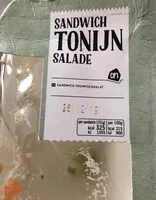
25% tarwebloem, water, groente (tomaat, friséesla), 14% tonijn, augurk, plantaardige olie (raap, geheel geharde raap), azijn, suiker, 1,3% maïsmeel, 1,3% maïsvlok, glucose-fructosestroop, 0,9% maïsgries, bakkersgist, zonnebloempit, tarwegluten, erwtenvezel, gejodeerd zout, scharreleigeel, verdikkingsmiddel (xanthaangom [E415], guarpitmeel [E412]), gemodificeerd maïszetmeel, 0,3% voorverstijfselde tarwebloem, meelverbeteraar (ascorbinezuur [E300]), 0,3% tarwemoutmeel, specerijen (o.a. mosterd), voedingszuur (melkzuur [E270], citroenzuur [E330]), zout, conserveermiddel (kaliumsorbaat [E202], natriumbenzoaat [E211]), natuurlijke aroma's (ei), antioxidant (extracten van rozemarijn [E392]), emulgator (mono- en diglyceriden van vetzuren [E471]), lecithinen [E322], kleurstof (carotenen [E160a], riboflavinen [E101]), vitaminen (A, D), aroma, zoetstof (sacharinen [E954]). Waarvan toegevoegde suikers 2.4g per 100 gram en waarvan toegevoegd zout 0.54g per 100 gram
- Energy208kcal
- Fat8.3 gmedium
- Sugars3.4 glow
- Salt0.8 gmedium
Per 100 g.
Prices€ 3,50 at Albert Heijn
- Albert Heijn€ 3,50€ 1,75 / piece
Price history
The price history appears here.
The line is the regular shelf price, read every week, without temporary offers. Updated 2026-09-01.
Alternatives
On the same shelf ›Similar
See allMore from AH
See all AH Egg wrap kip kruiden180 g · € 4,40C1 shop
 AH Meergranen sandwich bacon ei2 stuks · € 4,00D1 shopAH Sandwich bacon ei156 g · € 3,65C1 shopAH Sandwich kip met truffel smaak136 g · € 3,95C1 shop
 AH Volkoren sandwich mozarella tomaat2 stuks · € 3,50B1 shop
 AH Volkoren sandwich old amsterdam2 stuks · € 3,50D1 shop
More choice on this shelf
Lists, in Dutch, with every product’s ingredients; the number is how many are on it.
Without what this contains
- Filled rolls without egg18
- Filled rolls without mosterd20
- Filled rolls without vis33
- Everything without glutenevery shelf
Other choices for filled rolls
Something wrong? Report it
Label seen . The data is collected from supermarket websites and may differ from the pack.
Photos: Open Food Facts, CC BY-SA